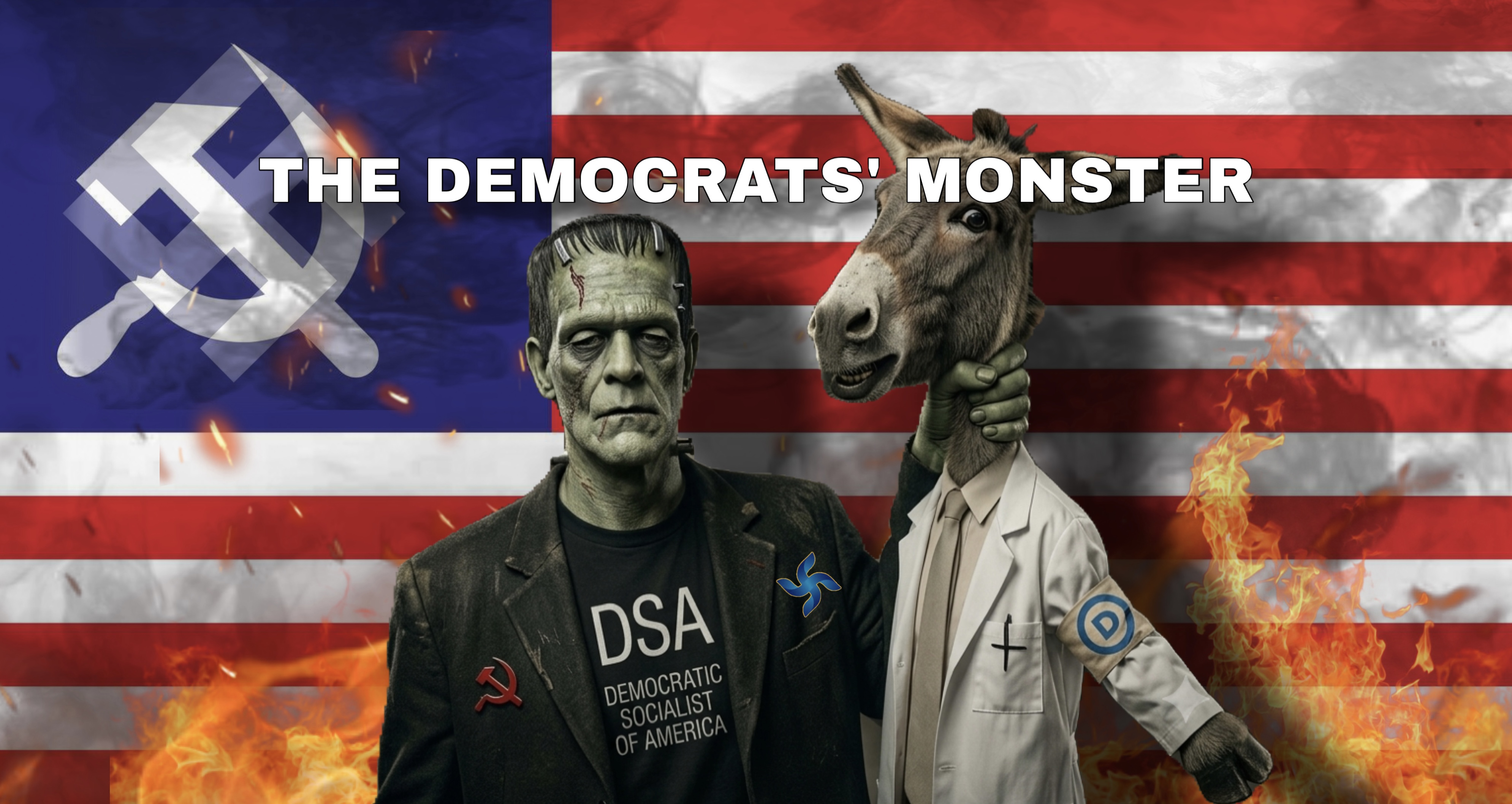
There is a particular horror reserved for the creator who loses control of his creation. Mary Shelley understood this. The doctor, having stitched together parts he barely comprehended and animated them with an ambition that outstripped his wisdom, recoiled the moment the creature opened its eyes. But recoil is not the same as escape. The thing he built demanded his allegiance. It pursued him. It destroyed everything he loved. And when the doctor finally understood the magnitude of his error, the monster did not accept his apology. It simply kept feeding.
The Democratic Party is living inside this story now, though its leaders seem to be the last to realize that the villagers with torches are not the problem. The problem is the thing they built, the thing they fed, the thing they told themselves was harmless, even noble. For more than a decade, the party opened its doors to the most radical elements of the American left, not out of conviction but out of cowardice and convenience. They needed the energy. They needed the online armies. They needed the fundraising lists and the viral clips and the moral legitimacy that comes from being flattered by people who call you a revolutionary while asking for the keys to your house. So they gave ground. And then more ground. And then the ground beneath their own feet.
What they invited in was not a partner. It was a force that regards the United States of America not as a nation to be improved but as an original sin to be expunged. This force demands open borders, viewing national sovereignty not as the guarantor of citizenship and self-rule but as an apparatus of racial exclusion to be dismantled. It demands the abolition of Immigration and Customs Enforcement, the one agency charged with stopping the flow of fentanyl that kills tens of thousands of Americans every year. It demands the abolition of prisons, treating the confinement of murderers and rapists as an injustice rather than the most basic duty a civilization owes its innocent members. It demands the radical restructuring of the family, of language, of biology itself, insisting that the material facts of human existence are merely oppressive constructs to be deconstructed by the poorly enlightened.
These are not policy disagreements. These are not differences of degree. These are the demands of an ideology that has declared war on the foundational premises of American life. And the Democratic Party, instead of showing this ideology the door, gave it a chairmanship.
The tragedy is not that the party lost its way. The tragedy is that it is losing its purpose. For all of American history, the two-party system has functioned, however imperfectly, as a mechanism of accountability. One party governs, the other opposes. One party proposes, the other critiques. The system works only when both parties accept the basic legitimacy of the American project, disagreeing on means while sharing a commitment to the ends: a nation of laws, of borders, of families, of prosperity, of ordered liberty under a Constitution. But what happens when one party can no longer say, with a straight face, that it believes in those things? What happens when its activist core regards expressions of patriotism as dog whistles, when its intellectual class treats capitalism as a crime, when its loudest voices describe the nuclear family as a site of oppression and law enforcement as an occupying army?
What happens is that the party ceases to function as a viable option for the American people. It becomes a vehicle for an ideology that the American people, in their stubborn and time-tested wisdom, reject at every opportunity. And because the party still exists structurally, still runs candidates, still occupies television studios and newspaper columns and endowed chairs at universities, it creates a vacuum where a loyal opposition should be. The country is left with a choice not between competing visions of American greatness but between one party that defends the nation and another that seems embarrassed by its existence.
The electoral implications are not speculative. They are already unfolding. The talk of a great blue resurgence, a wave that would sweep the party back to power in 2026 and restore the natural order as the liberal imagination understands it, is dissolving under the weight of its own absurdity. The American voter does not want prison abolition. The American voter does not want open borders. The American voter does not want the radical theories of gender ideology taught to their children or imposed on their daughters' sports. These are not close calls. They are not fifty-fifty propositions. They are landslides of public opinion that the Democratic Party, captive to its own extremist wing, cannot acknowledge without triggering an internal civil war it is terrified to fight.
And so the party prevaricates. It equivocates. It issues statements that are parsed like sacred texts, searching for some hidden code that will mollify the radicals without alarming the normals. It pretends that the most extreme voices in its coalition do not speak for it, even as it writes their priorities into its platforms and hands them the microphone at its conventions. It tells itself that this is a manageable problem, a messaging issue, a matter of tone and framing. This is self-deception on a scale that would be tragic if it were not so destructive.
The monster does not care about messaging. The monster does not care about electability. The monster does not care whether the Democratic Party survives the next election cycle or the one after that. The monster has its own objectives, its own theology, its own vision of the world remade in the image of its grievances. And the party, having summoned this creature to do its political bidding, is now discovering that the bargain runs only one way. The monster takes. It does not give. It consumes careers, reputations, institutions. It has consumed the basic biological categories of male and female. It has consumed the distinction between citizen and non-citizen. It has consumed the principle that those who violate the law should face consequences. And now, with its appetite still unsated, it is consuming the party itself.
Watching this unfold would be merely sad if it were not also clarifying. The American people are not stupid. They see the lawlessness in their cities and hear the explanations that blame law enforcement for enforcing laws. They see the chaos at the border and hear the insistence that borders are immoral. They see the price of groceries and the cost of energy and the struggle of building a decent life, and they hear lectures about the evils of capitalism from people who have never met a payroll. They are told that their concerns are racist, or sexist, or xenophobic, or some other word that has lost all meaning through overuse as a cudgel. And then they are asked, every two years, to vote for the party that has made a home for the people who despise them.
That is the question the Democratic Party cannot answer. Not because it lacks clever consultants or expensive pollsters, but because the answer would require it to say publicly what many of its leaders whisper privately: that the radicals are wrong, that borders matter, that families built on marriage are good, that capitalism has lifted billions from poverty, that men cannot become women by declaration, and that a nation without law enforcement is not a utopia but a war of all against all. The party cannot say these things because it is no longer allowed to. The permission structure has been dismantled. The language police have been deputized. The monster sits in judgment, and the party awaits its sentence.
So the poison spreads. The party that once represented working Americans now lectures them about their privilege. The party that once stood with law enforcement now demands abolition. The party that once understood that national boundaries are not expressions of hate but mechanisms of self-governance now treats any enforcement of immigration law as a moral failing. The party that once could produce figures like Daniel Patrick Moynihan, who warned with prophetic clarity about the disintegration of the black family, now cannot even define what a woman is. This is not evolution. It is dissolution. It is what happens when an institution abandons its foundations and discovers, too late, that it has built on air.
The coming election will not be a contest between equal alternatives. It will be a referendum on reality itself. One side will argue that borders, biology, and basic public order are not negotiable abstractions but prerequisites for any functioning society. The other side will try to explain why it is reasonable to abolish prisons while violent crime rises, why it is compassionate to dissolve immigration enforcement while fentanyl pours across the border, why it is progressive to treat the traditional family as a problem to be solved rather than a foundation to be protected. The American people will listen. They will consider the arguments. And they will render a verdict that the Democratic Party, in its current state of capture, is structurally incapable of understanding.
The creature that now inhabits and animates the Democratic Party will not go quietly. It will rage. It will accuse. It will burn the house down around itself before admitting error. But the American people, in their quiet and patriotic wisdom, have seen this movie before. They know how it ends. The only question is whether the party that enabled this disaster will find the courage to confront it before the door is sealed forever, or whether it will go to its grave insisting, until the final moment, that the monster is a misunderstood friend.