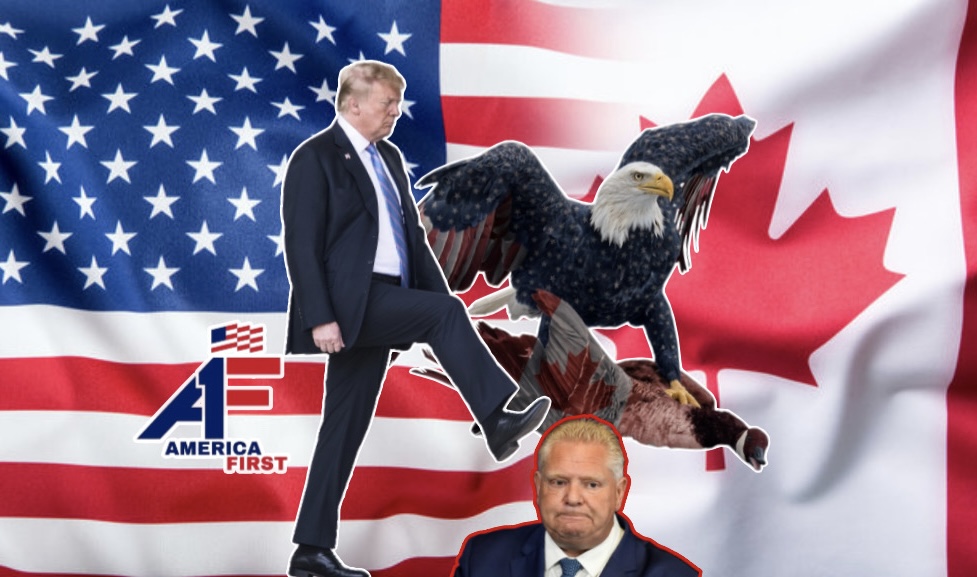
The foundational principle of national sovereignty is not a matter of courtesy; it is the bedrock upon which the legitimacy of any state rests. The American people possess the inalienable right to chart their own course, to select their own leaders, and to determine the fate of their own economy free from the coercive interference of foreign powers. It is a principle so elementary that it is rarely spoken aloud, yet in the current political climate, it is being openly and brazenly violated by a figure who possesses neither the authority nor the gravitas to speak for his own nation, let alone dictate terms to the United States.
The ongoing trade dispute between the United States and Canada has laid bare a reality that many in Washington have long preferred to ignore: Canada has, for decades, operated under the assumption that it is entitled to privileged access to the American market while simultaneously demanding the right to pursue protectionist policies that harm American workers. The data regarding this asymmetry is not ambiguous. The United States remains the destination for the vast majority of Canadian exports. Roughly one-third of everything Canada sold to the world in 2024 was energy, and fifteen percent was automobiles and parts; all flowing south into the American economy. The integration is so deep that the Bank of Canada itself has acknowledged the danger of the status quo, noting that automotive parts cross the border multiple times during production.
It is precisely this dependence that the American government is seeking to correct. Tariffs are not an act of aggression; they are a recalibration of a relationship that has slipped from fair trade into a state of economic parasitism. The case of dairy is illustrative. While Canada demands open access for its lumber and energy, it maintains a fortress of supply management that treats American farmers as adversaries. The assertion that Canadian tariffs can reach 250% is not hyperbole; it is arithmetic. For imports exceeding the quota, the rates are documented as approximately 241% for fluid milk and 298% for butter. This is not free trade; this is unilateral disarmament for the American producer and a windfall for the Canadian lobby.
In response to the legitimate assertion of American economic sovereignty, Canada has chosen the path of escalation. The threat to retaliate with dollar-for-dollar tariffs aimed at "red states," electricity grids, and critical minerals is a declaration of economic warfare against the American consumer. It is a strategy born of the false belief that pain inflicted on the American heartland will cause the United States to surrender its principles. This is a catastrophic miscalculation. The disparity in leverage is vast. Canada is a nation of 40 million people whose standard of living is tethered to the American consumer; the United States is the world’s largest economy. A trade war with the United States is a war Canada cannot win, and the rhetoric coming from the north suggests that the leadership there is too blinded by anti-American sentiment to see the cliff they are driving toward.
However, the economic data is not the most egregious aspect of the current crisis. The most egregious aspect is the conduct of Doug Ford, the Premier of Ontario. It must be stated clearly and without reservation: Doug Ford is not the Prime Minister of Canada. He is a provincial official, a regional administrator whose jurisdiction begins and ends at the borders of his province. Yet this man has seen fit to project himself onto the international stage, not as a guest, but as a combatant seeking to dictate the internal political affairs of the United States.
There is no legal framework, no diplomatic precedent, and no moral justification for a foreign sub-national leader to interfere in the elections of another country. The very notion is an insult to the American electorate. The United States is a republic, not a protectorate of Ontario. The machinery of American democracy does not answer to Queen’s Park. Doug Ford possesses no authority to demand a "seat at the table" because the table belongs to sovereign nations, not to provincial ministers grasping for relevance. His attempts to negotiate directly with American officials, bypassing the federal government of his own nation, reveal a delusional sense of importance. It is the behavior of a man who believes that the size of his province’s GDP grants him a mandate to meddle in the affairs of a superpower.
This overreach is compounded by the bellicosity of his language. Ford has framed the trade dispute not as a negotiation over tariffs, but as a conflict, threatening to cut off energy and critical minerals as if he were a general mobilizing troops. A willingness to "go to war"—economically or otherwise—over a dispute that Canada’s own policies initiated is not leadership; it is recklessness. It is the rhetoric of a man who has mistaken the patience of the United States for weakness.
The American response to this interference must be severe and uncompromising. The United States cannot allow a foreign official, however minor, to believe that he can threaten American sovereignty and influence American elections without consequence. If Canada is to understand the seriousness of this breach, the punishment must be felt where it matters most: in the balance sheets of the industries that fuel Ontario’s arrogance.
The United States possesses the leverage to make an example of this transgression. The inevitable restructuring of the North American supply chain, one that reduces American dependence on Canadian manufacturing, should be accelerated. The goal must be to bring the auto industry home, to open the dairy market, and to ensure that the infrastructure of Canada’s economy, from electricity to fertilizer, no longer holds a knife to the throat of the American farmer or factory worker. The tariffs levied against Canadian goods are not the end of a process; they are the beginning of a severance.
Doug Ford’s interference is the death rattle of a political class that has grown rich on American tolerance. The era of that tolerance is over. The American people do not negotiate with foreign interlopers; they sanction them. The message to Ontario, and to any other foreign body that seeks to meddle in the destiny of this Republic, must be clear: there is a price to be paid for such arrogance, and the bill is now due.